
Point-value climate at Gisborne. Population approximately 34,300.
Month-by-month details
| Month | TemperatureTemp | RainfallRain | Sunny daysSun | |
|---|---|---|---|---|
| January | 19.1°C66.4°F | 81 mm3.2″ | 13/31 | |
| February | 19°C66.2°F | 82 mm3.2″ | 11/29 | |
| March | 17.7°C63.9°F | 112 mm4.4″ | 12/31 | |
| April | 15.1°C59.2°F | 91 mm3.6″ | 13/30 | |
| May | 12.3°C54.1°F | 98 mm3.9″ | 12/31 | |
| June | 10.2°C50.4°F | 174 mm6.9″ | 11/30 | |
| July | 9.5°C49.1°F | 125 mm4.9″ | 13/31 | |
| August | 10.3°C50.5°F | 123 mm4.8″ | 13/31 | |
| September | 12°C53.6°F | 112 mm4.4″ | 13/30 | |
| October | 13.9°C57°F | 71 mm2.8″ | 13/31 | |
| November | 15.8°C60.4°F | 67 mm2.6″ | 13/30 | |
| December | 17.9°C64.2°F | 91 mm3.6″ | 14/31 |
More cities in New Zealand
 Auckland1.38M people · 153 sunny days / yr
 Wellington0.39M people · 162 sunny days / yr
 Christchurch0.36M people · 158 sunny days / yr
 Hamilton0.15M people · 120 sunny days / yr
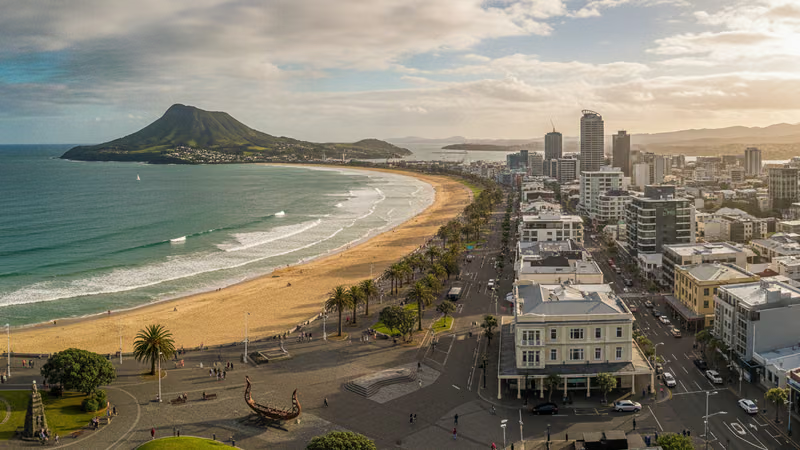 Tauranga0.12M people · 144 sunny days / yr
 Dunedin0.12M people · 122 sunny days / yr
 Hastings0.07M people · 154 sunny days / yr
 Nelson0.06M people · 150 sunny days / yr
Frequently asked questions
What is the best time to visit Gisborne?
Gisborne does not have a clearly "sunny" season by our profile cutoffs — see the "warmest and driest months" fallback for the closest picks. Gisborne's warmest month is January at an average of 19.1°C / 66.4°F, and its driest month is November with about 67 mm / 2.6 in of rain.
What is the climate of Gisborne?
Gisborne, in Gisborne, New Zealand, has monthly average temperatures ranging from 9.5°C / 49.1°F in July to 19.1°C / 66.4°F in January. Annual rainfall is approximately 1227 mm / 48.3 in, with the wettest month being June (174 mm / 6.9 in) and the driest November (67 mm / 2.6 in).
What is the average temperature in Gisborne in January?
The average temperature in Gisborne in January is 19.1°C / 66.4°F, with rainfall of about 81 mm / 3.2 in — the warmest month of the year.
When is the driest month in Gisborne?
The driest month in Gisborne is November, with about 67 mm / 2.6 in of average monthly rainfall. Average temperature that month is 15.8°C / 60.4°F.
When is the wettest month in Gisborne?
The wettest month in Gisborne is June, with approximately 174 mm / 6.9 in of average monthly rainfall.
How many sunny days does Gisborne get?
Gisborne averages around 151 sunny days per year. The sunniest month is December (14 sunny days out of 31), and the cloudiest is February (11 sunny days). These are derived from ECMWF ERA5 reanalysis radiation fields (1991–2020), calibrated against published climate normals.
About the climate in Gisborne
Located in Gisborne, New Zealand, Gisborne has a seasonal climate. Population approximately 34,300. Monthly average temperatures range from 9.5°C / 49.1°F in July to 19.1°C / 66.4°F in January, with rainfall varying from 67 mm / 2.6 in (November) to 174 mm / 6.9 in (June) — about 1227 mm / 48.3 in across the year. Gisborne averages about 151 sunny days a year, peaking in December (14) and lowest in February (11). Gisborne is the capital of Gisborne. These are point-value climate normals sampled at Gisborne's coordinates — often quite different from the surrounding region's area-weighted average.